
join our whatsapp channel
Answers to Questions 1-10
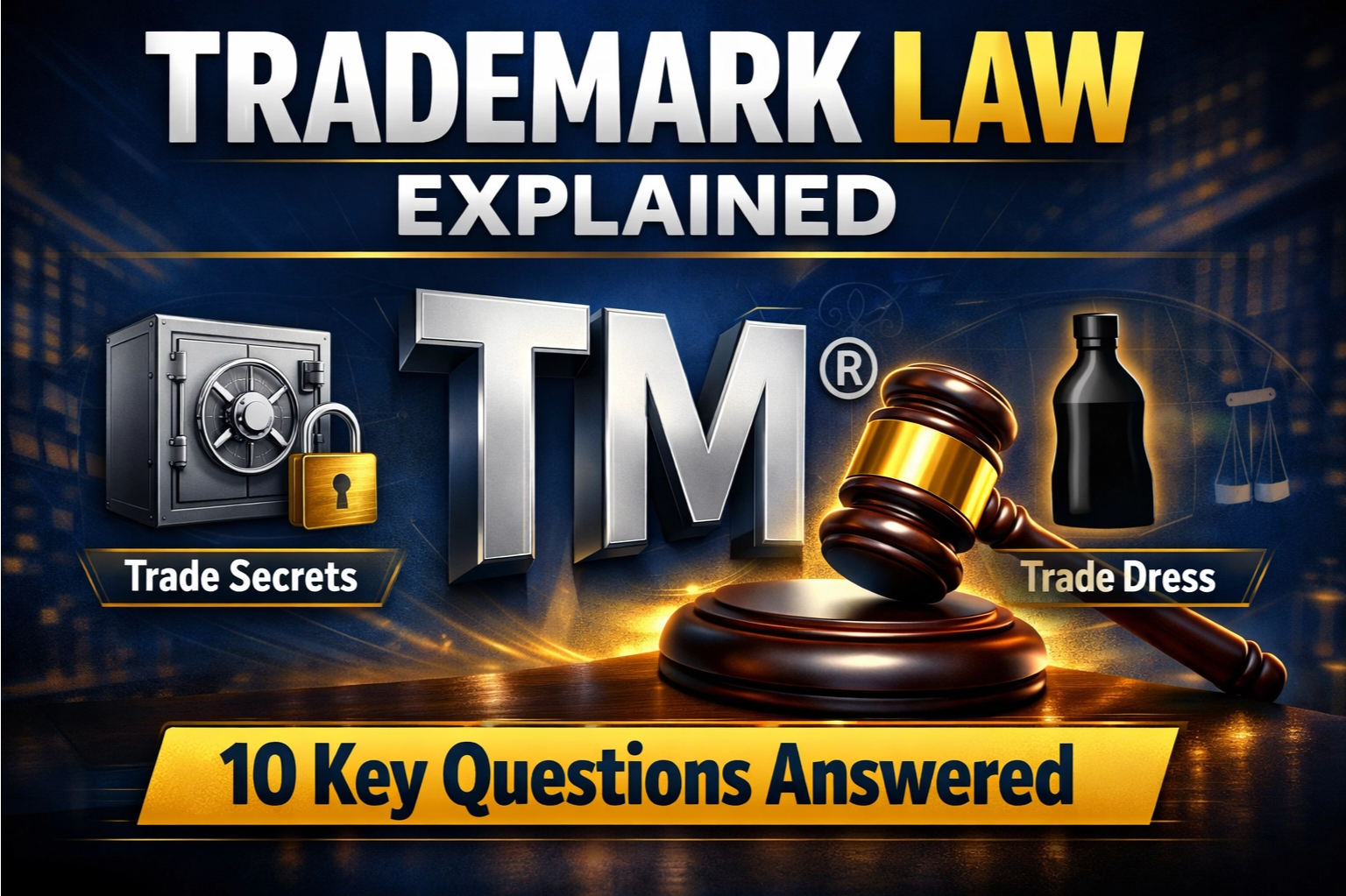
The following answers are based on the provided reading material on Trademark, Trade Dress, and Trade Secrets.
Question 1
Which of the following is an essential characteristic of a trade secret?
•Correct Answer: It must be original and secret.
•Justification: The text states, “To be entitled to protection, a trade secret must be 1) original and 2) secret.” (Line 115)
Question 2
Which of the following marks is likely to be considered arbitrary?
•Correct Answer: Windows for software
•Justification: An arbitrary mark uses a real word that is not associated with the product. The text gives “Apple” for computers as the common example (Line 32). “Windows” is a real word, but it has no inherent connection to computer operating system software. The other options are either descriptive (“Fast” for delivery, “Sweet” for candy) or not a strong example of an arbitrary mark.
Question 3
What distinguishes arbitrary trademarks from other types?
•Correct Answer: They are real words that have no relation to the product.
•Justification: The text defines arbitrary marks as those that “consist of real words in common usage, but are not associated with the product or service being sold.” (Line 32)
Question 4
Which of the following is an example of trade dress?
•Correct Answer: The distinctive shape and color of a soda bottle
•Justification: The text states that trade dress “protects the overall look and feel (for example, design and shape) of a product” and “may include features such as size, shape, color or color combinations, texture, graphics, or even certain sales techniques.” (Lines 89-92)
Question 5
What can companies do if another company dilutes their trademark?
•Correct Answer: They can bring lawsuits against the diluting company.
•Justification: The text mentions the federal Trademark Dilution Act of 1995, under which “companies can bring lawsuits against other companies that dilute the value of the senior trademark.” (Line 78)
Question 6
What does it mean for a trademark to acquire secondary meaning?
•Correct Answer: It is recognized by consumers as identifying a specific source.
•Justification: The text explains that a mark receives secondary meaning “when consumers at large associate the mark with the product and not the more broad description of terms.” (Line 42)
Question 7
What are the two main requirements for trade dress protection?
•Correct Answer: It must be inherently distinctive and non-functional.
•Justification: The text lists the two requirements for unregistered trade dress protection as: “Distinctive” and “Non-functional.” (Lines 96-97)
Question 8
Which type of trademark requires logic and imagination to connect it to the product?
•Correct Answer: Suggestive
•Justification: The text states that suggestive marks “require a bit of imagination” to connect them to the product’s characteristics. (Line 35)
Question 9
What is the role of the USPTO in trademark registration?
•Correct Answer: To review applications for distinctiveness and potential confusion
•Justification: The text says, “The USPTO reviews the application for distinctiveness, and third parties may contest the application if they feel that the mark would create confusion with their own marks.” (Line 50)
Question 10
Which of the following is an example of a fanciful trademark?
•Correct Answer: Xoxoppuluppu for cameras
•Justification: Fanciful marks “tend to be terms that are made up” (Line 29). “Xoxoppuluppu” is a made-up word, while the other options are real words used arbitrarily (“Apple”), descriptively (“Cleanburn”), or generically (“FastFood”).