
join our whatsapp channel
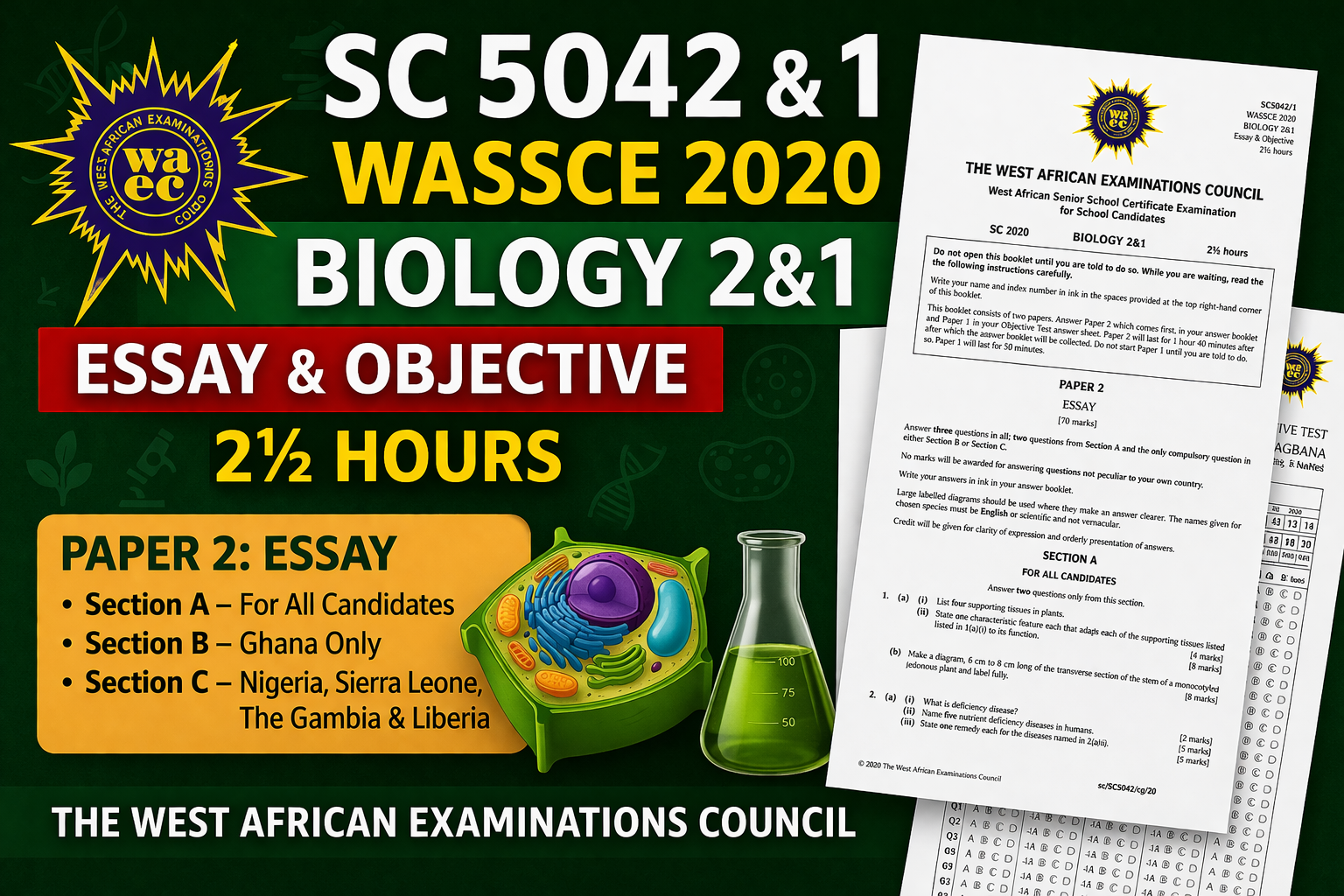
SC5042&1
WASSCE 2020
BIOLOGY 2&1
Essay & Objective
2½ hours
THE WEST AFRICAN EXAMINATIONS COUNCIL
West African Senior School Certificate Examination
for School Candidates
SC 2020 BIOLOGY 2&1 2½ hours
Do not open this booklet until you are told to do so. While you are waiting, read the following instructions carefully.
Write your name and index number in ink in the spaces provided at the top right-hand corner of this booklet.
This booklet consists of two papers. Answer Paper 2 which comes first, in your answer booklet and Paper 1 in your Objective Test answer sheet. Paper 2 will last for 1 hour 40 minutes after which the answer booklet will be collected. Do not start Paper 1 until you are told to do so. Paper 1 will last for 50 minutes.
© 2020 The West African Examinations Council
sc/SC5042/cg/20
PAPER 2
ESSAY
[70 marks]
Answer three questions in all; two questions from Section A and the only compulsory question in either Section B or Section C.
No marks will be awarded for answering questions not peculiar to your own country.
Write your answers in ink in your answer booklet.
Large labelled diagrams should be used where they make an answer clearer. The names given for chosen species must be English or scientific and not vernacular.
Credit will be given for clarity of expression and orderly presentation of answers.
SECTION A
FOR ALL CANDIDATES
Answer two questions only from this section.
1. (a) (i) List four supporting tissues in plants.
(ii) State one characteristic feature each that adapts each of the supporting tissues listed in 1(a)(i) to its function.
[4 marks]
[8 marks]
(b) Make a diagram, 6 cm to 8 cm long of the transverse section of the stem of a monocotyledonous plant and label fully.
[8 marks]
2. (a) (i) What is deficiency disease?
(ii) Name five nutrient deficiency diseases in humans.
(iii) State one remedy each for the diseases named in 2(a)(ii).
[2 marks]
[5 marks]
[5 marks]
(b) Outline a chemical test for:
(i) glucose in orange fruit;
(ii) starch in a tuber of yam.
[4 marks]
[4 marks]
3. (a) Explain briefly food preservation in the following facilities:
(i) silo;
(ii) refrigerator.
[6 marks]
(b) List four examples each of food types that can be preserved in the facilities in 3(a)(i) and 3(a)(ii).
[8 marks]
(c) List six factors that affect population size of living organisms.
[6 marks]
4. (a) Explain briefly the reason why blood groups A and B in humans can exist both in the heterozygous and homozygous forms while blood group O can only exist in homozygous form.
[5 marks]
(b) (i) Name the Classes of vertebrates in order of their evolutionary trend.
[5 marks]
(ii) Give one example each of the Classes of vertebrates named in 4(b)(i).
[5 marks]
(c) Explain briefly independent assortment of genes.
[5 marks]
SECTION B
FOR CANDIDATES IN GHANA ONLY
Answer the questions in this section.
5. (a) (i) What is guttation?
[2 marks]
(ii) Explain briefly the biological principles underlying the process of guttation.
[4 marks]
(b) (i) List three organelles in the cell that are involved in protein synthesis.
[3 marks]
(ii) Name one source of amino acids used in protein synthesis in cells.
[1 mark]
(c) Outline the steps taken to change from viewing an object placed under a low power magnification to a high power magnification when using an optical microscope.
[4 marks]
(d) Describe briefly the process of dissecting a rabbit to expose its alimentary canal.
[6 marks]
(e) Name six life processes which living organisms are capable of performing.
[6 marks]
(f) Name the branch of Biology which is concerned with the study of:
(i) tissues;
(ii) plants;
(iii) DNA;
(iv) the environment.
[4 marks]
SECTION C
FOR CANDIDATES IN NIGERIA, SIERRA LEONE, THE GAMBIA AND LIBERIA
Answer the questions in this section.
6. (a) Explain briefly the following types of fertilization in animals:
(i) external fertilization;
(ii) internal fertilization.
[4 marks]
(b) Name two groups of animals each that exhibit the types of fertilization in 6(a)(i) and (ii).
[4 marks]
(c) (i) If the placenta in a pregnant woman is detached from the uterine wall, give three effects this would have on the foetus.
[3 marks]
(ii) Name three other features present in the uterus of a pregnant woman useful for the development of the foetus.
[3 marks]
(d) Explain briefly how the activities of organisms bring about dynamic equilibrium in the habitat.
[4 marks]
(e) State four problems that organisms in the intertidal zone of a marine habitat could encounter.
[4 marks]
(f) Explain briefly the reason the following factors are necessary for germination:
(i) moisture;
(ii) viable seed.
[4 marks]
(g) Explain briefly the reason light energy is considered a limiting factor in the production of food by autotrophs.
[4 marks]
END OF ESSAY TEST
DO NOT TURN OVER THIS PAGE UNTIL YOU ARE TOLD TO DO SO.
YOU WILL BE PENALIZED SEVERELY IF YOU ARE FOUND LOOKING AT THE NEXT PAGE BEFORE YOU ARE TOLD TO DO SO.
PAPER 1
OBJECTIVE TEST
[50 marks]
50 minutes
1. Use 2B pencil throughout.
2. On the pre-printed answer sheet, check that the following details are correctly printed:
(a) In the space marked Name, check your surname followed by your other names.
(b) In the spaces marked Examination, Year, Subject and Paper, check ‘WASSCE’, ‘SC 2020’, ‘BIOLOGY’, and ‘1’ in that order.
(c) In the box marked Index Number, your index number has been printed vertically in the spaces on the left-hand side, and each numbered space has been shaded in line with each digit. Reshade each of the shaded spaces.
(d) In the box marked Subject Code, the digits 504113 are printed vertically in the spaces on the left-hand side. Reshade the corresponding numbered spaces as you did for your index number.
3. An example is given below. This is for a male candidate whose name is Elliot Kofi AGBANA. His index number is 7102143958 and he is offering Biology 1.
THE WEST AFRICAN EXAMINATIONS COUNCIL
ANSWER SHEET
Answer all the questions.
Each question is followed by four options lettered A to D. Find the correct option for each question and shade in pencil on your answer sheet, the answer space which bears the same letter as the option you have chosen.
Give only one answer to each question. An example is given below.
Which part of the gill of fish is involved in gaseous exchange?
A. Gill slits
B. Gill bars
C. Gill covers
D. Gill filaments
The correct answer is Gill filaments, which is lettered D, and therefore answer space D would be shaded.
Think carefully before you shade the answer spaces; erase completely any answers you wish to change.
Do all rough work on this question paper.
Now answer the following questions.
1. The cell as the basic unit of life consists of
A. cytoplasm and vacuole.
B. cytoplasm and nucleus.
C. nucleus and cell wall.
D. cell wall and vacuole.
Use the following Classes of Arthropoda to answer questions 2 and 3.
I. Crustacea
II. Insecta
III. Arachnida
IV. Chilopoda
2. Which members of the Classes live mainly in an aquatic habitat?
A. I
B. II
C. III
D. IV
3. Which of the Classes is characterized by the possession of two pairs of antennae?
A. IV
B. III
C. II
D. I
4. The organism with spiral chloroplasts and nucleus suspended by cytoplasmic strands is
A. Euglena.
B. Paramecium.
C. Spirogyra.
D. Volvox.
5. The network of double membrane that conveys materials through the cytoplasm is the
A. endoplasmic reticulum.
B. mitochondrion.
C. nuclear membrane.
D. plasma membrane.
The diagram below is an illustration of the longitudinal section of a plant organ. Study it and answer questions 6 to 8.
6. Food is stored in the part labelled
A. IV.
B. III.
C. II.
D. I.
7. The plant is a
A. runner.
B. stolon.
C. bulb.
D. stem tuber.
8. The part labelled I is the
A. fleshy leaf.
B. adventitious root.
C. scale leaf.
D. apical bud.
9. Which of the following materials is not a living semi-permeable membrane?
A. Sheet of cellophane
B. Yam tuber
C. Unripe pawpaw fruit
D. Pig’s bladder
10. In an experiment, mould and yeast cells were transferred into an environment with low oxygen concentration. After a few days, the mould died while the yeast cells did not. Which of the following statements best explains the above observation?
A. Respiration does not occur in the mould
B. Respiration can take place in yeast cells in the absence of oxygen
C. Photosynthesis does not take place in the absence of oxygen
D. The yeast cells carried out photosynthesis while the mould did not
11. Which of the following tissues does not provide support in flowering plants?
A. Phloem
B. Xylem
C. Parenchyma
D. Collenchyma
The diagram below is an illustration of an experimental set-up. Study it and answer questions 12 and 13.
[Diagram: Potometer — shoot supported by clamp, rubber tubing, syringe, capillary tubing, air bubble, water reservoir]
12. The set-up directly measures
A. loss of mineral salts from the leaves.
B. absorption of water by the shoot.
C. evaporation of water from the leaves.
D. transpiration of water by the shoot.
13. The set-up can measure comparatively the rate of
A. water uptake by roots of different plants.
B. transpiration of a single shoot of a plant under different experimental conditions.
C. salt uptake by shoots from different plants.
D. evaporation from leaves on a single shoot under different experimental conditions.
14. The respiratory organ of a cockroach is the
A. lung.
B. lung book.
C. trachea.
D. air sac.
15. The excretory product of some reptiles, birds and insects is
A. uric acid.
B. ammonia.
C. urine.
D. urea.
16. The part of the mammalian kidney that stores urine is the
A. bladder.
B. pelvis.
C. medulla.
D. capsule.
17. The properties of endocrine system include the following except
A. release of secretions into ducts.
B. having specific effect.
C. transportation by blood to target organs.
D. secretion of hormones.
18. The part of the central nervous system that controls unconscious actions in humans is the
A. optic nerves.
B. spinal cord.
C. cerebrum.
D. cerebellum.
19. What happens when the ciliary muscles of the eye contract? The
A. suspensory ligament becomes tight.
B. lens gets a longer focal length.
C. lens becomes more convex.
D. lens becomes more concave.
The diagram below is an illustration of a part of a flower. Study it and answer questions 20 and 21.
[Diagram: Pistil showing parts labelled I (stigma/style area) and II (ovary/style)]
20. The function of the part labelled I is
A. site for double fertilization in the plant.
B. germination of the pollen grain.
C. passage for the male gamete to the ovary.
D. receiving the pollen grain.
21. The part labelled II is the
A. unfused anthers.
B. fused ovaries.
C. fused style.
D. unfused stigma.
22. The reagent used in testing for carbon (IV) oxide is
A. copper sulphate solution.
B. lime water.
C. hydrochloric acid.
D. sodium hydroxide solution.
23. Oxygen comes out of the stomata during photosynthesis through the process known as
A. active transport.
B. osmosis.
C. transpiration pull.
D. diffusion.
24. The first stable product of photosynthesis is
A. sucrose.
B. glucose.
C. fructose.
D. starch.
25. An example of a trace element is
A. copper.
B. magnesium.
C. calcium.
D. potassium.
26. Which of the following statements about a mixture of a protein-digesting enzyme and starch solution would be correct? The protein digesting enzyme
A. digests the starch.
B. leads to the production of glucose.
C. leads to the production of amino acids.
D. has no effect on the starch solution.
27. A mutualism type of relationship is different from a parasitic relationship because in mutualism,
A. only one of the organisms is harmed.
B. both organisms harm each other.
C. none of the organisms benefits or harms each other.
D. both organisms involved benefit.
The table below shows the number of some organisms in habitats W and Y. Study it and answer questions 28 to 30.
| Organism | habitat W | habitat Y |
| Plankton | 126 | 0 |
| Antelope | 0 | 51 |
| Water flea | 10 | 0 |
| Tilapia | 23 | 0 |
| Lion | 0 | 6 |
| Frog | 6 | 0 |
| Grass | 0 | 250 |
28. What type of habitat is W?
A. Ocean
B. Desert
C. Pond
D. Rainforest
29. Which of the following statements about habitat W is correct? The
A. absence of grasses indicates the habitat is terrestrial.
B. type of organisms present indicate the habitat is aquatic.
C. presence of tilapia and planktons shows the habitat is not aquatic.
D. absence of lions and antelopes shows the habitat is terrestrial.
30. The number of lions and antelopes in habitat Y shows that the lion
A. and the antelope are predators.
B. and the antelope are preys to each other.
C. is the predator while the antelope is the prey.
D. is the prey while the antelope is the predator.
The diagram below is an illustration of an ecological instrument. Study it and answer questions 31 and 32.
[Diagram: Rain gauge]
31. A disadvantage of the abiotic factor measured by the instrument is that it
A. is used for irrigation.
B. leads to flooding when in excess.
C. is necessary for germination.
D. is an agent of pollination.
32. When the instrument is in use, it is usually
A. suspended on moving water.
B. suspended in air.
C. placed on a table.
D. placed slightly above soil level.
33. Soil with the finest texture is
A. gravel.
B. sand.
C. clay.
D. silt.
34. The position occupied by an organism in a food chain is the
A. energy level.
B. niche.
C. trophic level.
D. biomass.
35. The depletion of the ozone layer will result in the earth surface receiving more
A. X-rays.
B. ultraviolet rays.
C. Infra-red rays.
D. gamma rays.
Use the list of insects below to answer questions 36 and 37.
I. Cotton stainer
II. Honeybee
III. Termite
IV. Weevil
36. The insects whose activities are both beneficial and harmful to humans are
A. III and IV.
B. II and IV.
C. II and III.
D. I and II.
37. Which of the insects destroys grains?
A. IV
B. III
C. II
D. I
38. Conservation of natural resources does not
A. threaten the survival of species.
B. attract tourists.
C. preserve the beauty of nature.
D. maintain a balanced ecosystem.
39. A company was prohibited from producing bags made from natural leopard skin. This is an attempt to conserve
A. minerals.
B. wildlife.
C. water.
D. land.
40. Which of the following substances is not a conservable natural resource?
A. Water
B. Soil
C. Air
D. Mineral
41. A child that can receive blood from anybody belongs to the blood group
A. AB.
B. B.
C. A.
D. O.
42. Variation which exhibits a wide range from one extreme to the other is
A. genotypic variation.
B. continuous variation.
C. discontinuous variation.
D. phenotypic variation.
43. Measurements of height and weight of students in a class show
A. fatness is less prevalent.
B. shortness is more prevalent.
C. continuous variation.
D. discontinuous variation.
44. Which of the following statements about chromosomes is correct?
A. They bear ribosomes on their outer membranes.
B. They are neatly arranged in the cytoplasm.
C. The number present in a species is constant.
D. All the chromosomes of a species are the same in shape.
45. Which of the following diseases can be inherited?
A. Malaria
B. Sickle cell anaemia
C. Whooping cough
D. Pneumonia
The diagram below is an illustration of a cross between plants A and B of the same species. Study it and answer questions 46 and 47.
[Diagram: Genetic cross — Plant A: YY rr (high yield Y, low resistance r) × Plant B: yy RR (low yield y, high resistance R) → F1 generation]
46. If the F1 generation are plants with high yield and high resistance, the genotype of the F1 generation plants would be
A. yyrr.
B. yyRr.
C. YyRr.
D. YYRR.
47. The process that gave rise to the F1 generation is
A. test cross.
B. out-breeding.
C. cross fertilization.
D. self fertilization.
48. Replication of DNA molecules is catalysed by an enzyme called
A. amylase.
B. pepsin.
C. ptyalin.
D. polymerase.
49. Who proposed the theory of evolution by natural selection?
A. Linnaeus
B. Aristotle
C. Lamarck
D. Darwin
50. Which of the following statements best explains the reason why termites swarm at night?
A. They can only see in the dark
B. Light destroys their wings
C. They avoid day-flying birds
D. Light is not necessary for swarming
END OF PAPER
SC5043
WASSCE 2020
BIOLOGY 3
Practical
2 hours
THE WEST AFRICAN EXAMINATIONS COUNCIL
West African Senior School Certificate Examination
for School Candidates
SC 2020 BIOLOGY 3 2 hours
PRACTICAL
Write your name and index number in ink in the spaces provided above.
Answer all the questions in Section A, and in addition all the questions in either Section B or C.
No mark will be awarded for answering questions from any part not peculiar to your own country.
Write your answers in your practical answer booklet.
Use both sides of the blank sheets in your answer booklet for writing and drawing.
Work done on any paper other than that provided will receive no mark.
You are advised to use sharp pencils for your drawings. Do not shade or colour. Great importance is attached to the accuracy of all drawings and observations.
SECTION A
[50 marks]
FOR ALL CANDIDATES
Answer all the questions in this section.
1. Study specimens A and B and answer questions 1(a) to 1(e).
(a) (i) Name the class to which specimen B belongs. [1 mark]
(ii) State two reasons for the answer in 1(a)(i). [2 marks]
(b) (i) Name the habitat of specimen A. [1 mark]
(ii) State one structural feature that adapts specimen A to its habitat. [2 marks]
(c) (i) In a tabular form, state two observable structural differences between specimens A and B. [2 marks]
(ii) State two observable structural similarities between specimens A and B. [2 marks]
(d) (i) What is the symmetry of specimen B? [1 mark]
(ii) Name one tool each which could be used to collect samples of specimens A and B for scientific studies. [2 marks]
(iii) Name two structures in specimen B that could be affected by oil spillage in its habitat. [2 marks]
(e) Make a drawing, 6 cm to 8 cm long of the ventral view of specimen A and label fully. [10 marks]
2. Study specimens D, G and H and answer questions 2(a) to 2(e).
(a) (i) Place two drops of specimen D on a white tile and add two drops of iodine solution. Copy and complete the table below, stating the test, observation and inference.
| Test | Observation | Inference |
[3 marks]
(ii) Put 5 ml of specimen D into a test tube and add 2 ml of sodium hydroxide solution followed by three drops of copper (II) tetraoxosulphate (VI) and shake. Copy and complete the table below, stating the test, observation and inference.
| Test | Observation | Inference |
[3 marks]
(iii) Give the name of each of the tests in 2(a)(i) and 2(a)(ii).
[2 marks]
(b) State two ways by which specimen G is of economic importance.
[2 marks]
(c) (i) Name the kingdom to which specimen G belongs.
[1 mark]
(ii) State two reasons for the answer in 2(c)(i).
[2 marks]
(iii) Name four other organisms that belong to the same kingdom as specimen G.
[4 marks]
(d) (i) Name the Phylum to which specimen H belongs.
[2 marks]
(ii) State three reasons for the answer in 2(d)(i).
[3 marks]
(e) (i) Explain briefly the role of specimen G in nutrient recycling.
[2 marks]
(ii) What is the mode of nutrition of specimen G?
[1 mark]
SECTION B
[30 marks]
FOR CANDIDATES IN GHANA ONLY
Answer the questions in this section.
3. Study specimens J, K, L and M and answer questions 3(a) to 3(g).
(a) Classify specimen J into its:
(i) Phylum,
(ii) Class.
[2 marks]
(b) State two reasons each for the answers in 3(a)(i) and (ii).
[4 marks]
(c) Use arrows to indicate the relationship among specimens J, K and L in a cycle.
[4 marks]
(d) (i) State two observable characteristic features that adapt specimen L to its habitat.
[4 marks]
(ii) State two observable structures that adapt specimen M to its habitat.
[4 marks]
(e) In a tabular form, state two observable structural differences between specimens J and M.
[2 marks]
(f) (i) Name one habitat each of specimens J and M.
[2 marks]
(ii) State three ways each by which specimens J and M are of economic importance.
[6 marks]
(g) Classify specimen M into:
(i) Division;
(ii) Class.
[2 marks]
SECTION C
[30 marks]
FOR CANDIDATES IN NIGERIA, SIERRA LEONE, THE GAMBIA AND LIBERIA
Answer the questions in this section.
4. Study specimens N, P, Q, R, S and T and answer questions 4(a) to 4(c).
(a) (i) Copy and complete the table below by placing each of specimens N, P, Q, R, S and T under the appropriate headings.
| Dry indehiscent fruit | Dry dehiscent fruit | Succulent Fruit |
[6 marks]
(ii) Name the type of fruit to which each of specimens N, P, Q, R, S and T belongs.
[6 marks]
(iii) State three observable structural differences between specimens S and T.
[3 marks]
(b) State two observable features of biological importance of each of specimens N, P and T.
[6 marks]
(c) Make a drawing, 6 cm to 8 cm long of specimen T and label fully.
[9 marks]
END OF PAPER
© 2020 The West African Examinations Council
Here are the answers to the Paper 1 Objective Test (50 MCQs):
| Q | Answer | Reason |
|---|---|---|
| 1 | B | Cytoplasm and nucleus |
| 2 | A | Crustacea (I) live mainly in aquatic habitats |
| 3 | D | Crustacea (I) have two pairs of antennae |
| 4 | C | Spirogyra has spiral chloroplasts and nucleus on cytoplasmic strands |
| 5 | A | Endoplasmic reticulum is the double membrane network |
| 6 | B | Food stored in fleshy leaves (III) of a bulb |
| 7 | C | The plant is a bulb |
| 8 | C | Part I is the scale leaf |
| 9 | A | Cellophane is not a living semi-permeable membrane |
| 10 | B | Yeast respires anaerobically (without oxygen) |
| 11 | C | Parenchyma does not provide support |
| 12 | D | The potometer measures transpiration by the shoot |
| 13 | B | It compares transpiration of one shoot under different conditions |
| 14 | C | Cockroach breathes through tracheae |
| 15 | A | Reptiles, birds and insects excrete uric acid |
| 16 | B | The renal pelvis collects/stores urine in the kidney |
| 17 | A | Endocrine glands secrete into blood, not ducts |
| 18 | B | Spinal cord controls unconscious (reflex) actions |
| 19 | C | Ciliary muscle contraction → suspensory ligament slackens → lens bulges (more convex) |
| 20 | D | Part I (stigma) receives the pollen grain |
| 21 | C | Part II is the fused style |
| 22 | B | Lime water tests for CO₂ |
| 23 | D | Diffusion moves O₂ out of stomata |
| 24 | B | Glucose (GP3 / G3P) is the first stable product |
| 25 | A | Copper is a trace element |
| 26 | D | A protein-digesting enzyme has no effect on starch |
| 27 | D | In mutualism, both organisms benefit |
| 28 | C | Habitat W (plankton, tilapia, water flea, frog) is a pond |
| 29 | B | Type of organisms present indicate it is aquatic |
| 30 | C | Lion is predator; antelope is prey |
| 31 | B | Rain (measured by rain gauge) leads to flooding when in excess |
| 32 | D | Rain gauge is placed slightly above soil level |
| 33 | C | Clay has the finest texture |
| 34 | C | Trophic level is the position in a food chain |
| 35 | B | Ozone depletion → more ultraviolet rays reach Earth |
| 36 | C | Honeybee (II) and Termite (III) are both beneficial and harmful |
| 37 | A | Weevil (IV) destroys grains |
| 38 | A | Conservation does NOT threaten species survival |
| 39 | B | Banning leopard skin products conserves wildlife |
| 40 | C | Air is not a conservable natural resource in the same sense |
| 41 | A | Blood group AB is the universal recipient |
| 42 | B | Continuous variation shows a wide range between extremes |
| 43 | C | Height and weight show continuous variation |
| 44 | C | Chromosome number in a species is constant |
| 45 | B | Sickle cell anaemia is inherited |
| 46 | C | YyRr — heterozygous for both traits |
| 47 | C | Cross fertilization produced the F₁ generation |
| 48 | D | DNA polymerase catalyses DNA replication |
| 49 | D | Darwin proposed natural selection |
| 50 | C | Termites swarm at night to avoid day-flying birds |